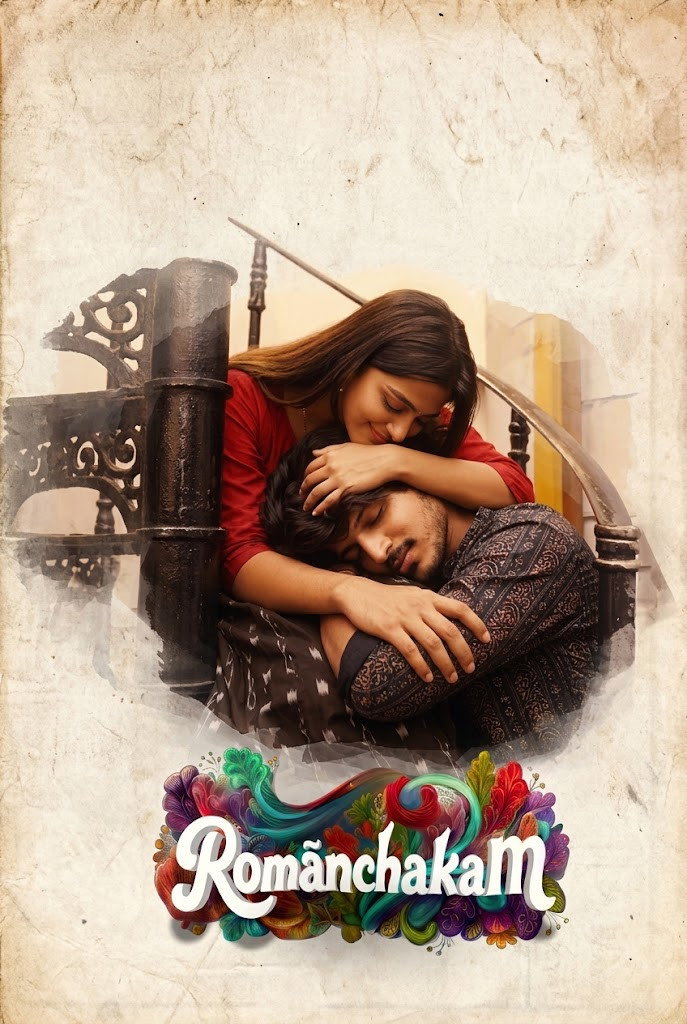
Overview & Production Details
Romanchakam (2026) Critical Review
Narrative Premise & Modern Digital Commentary
Directed by Venu Gopal Reddy, Romanchakam ventures into the familiar ecosystem of college graduates navigating post-academic uncertainty, but gives it a modern techno-entrepreneurial spin. The story follows a charismatic yet arrogant young engineering graduate who assumes that tech entrepreneurship is merely a game of optics and hustle culture. In an attempt to monetize modern loneliness and validate his own ego, he engineers a niche dating platform. However, the lighthearted commercial enterprise quickly turns chaotic when an ambiguous, hyper-personalized profile named Mythili enters his digital crosshairs.
The film deliberately steps away from conventional meet-cute tropes. Instead of framing modern dating as an easy rom-com playground, the screenplay interrogates how digital anonymity and virtual personas warp real emotional connections. As the protagonist slips into an obsessive pursuit to discover the real woman behind the screen, the project spirals into financial collapse, driving deep wedges between him and his loyal group of co-founders.
Performances & Character Dynamics
Sumanth Prabhas shoulders the central role with a calibrated mix of swagger and underlying anxiety. He avoids making the protagonist entirely unlikable; rather, he portrays him as a victim of his own unearned pride. His transitions between sharp, comedic improvisations with his buddies to quiet, vulnerable moments of introspection keep the emotional stakes grounded.
Ananthika Sanilkumar, portraying Mythili, brings mystery and quiet dignity to the narrative. Rather than operating purely as a manic pixie dream girl, her presence acts as a catalytic mirror that forces the protagonist to assess his moral shortcuts. Upendra Limaye and Venkatesh Kakumanu deliver sharp supporting performances, anchoring the surrounding world with authentic comic timing and genuine camaraderie.
Direction, Visuals, and Technical Craft
Venu Gopal Reddy displays an impressive control over tonality. The first half is brisk, vibrant, and packed with energetic youth banter, while the second half leans into a more reflective, introspective rhythm. The technical execution elevates the film above standard regional comedies. Pavan Kumar Pappula’s cinematography captures the chaotic pulse of Hyderabad’s urban pockets, utilizing warm natural tones during daytime interactions and neon, high-contrast framing during late-night digital searches.
The musical score composed by Vasuki Vaibhav integrates seamlessly with the plot. The background cues refrain from suffocating dramatic beats, allowing emotional realizations to breathe naturally without relying on heavy orchestral melodrama.
Final Verdict
Romanchakam manages to deliver both entertaining youth comedy and an insightful character study on contemporary ego, startup hubris, and algorithmic romance. While a few subplot resolutions in the final act feel slightly hurried, the emotional payoff and disciplined performances make it a thoroughly engaging watch.